8.4. Dislocation helix
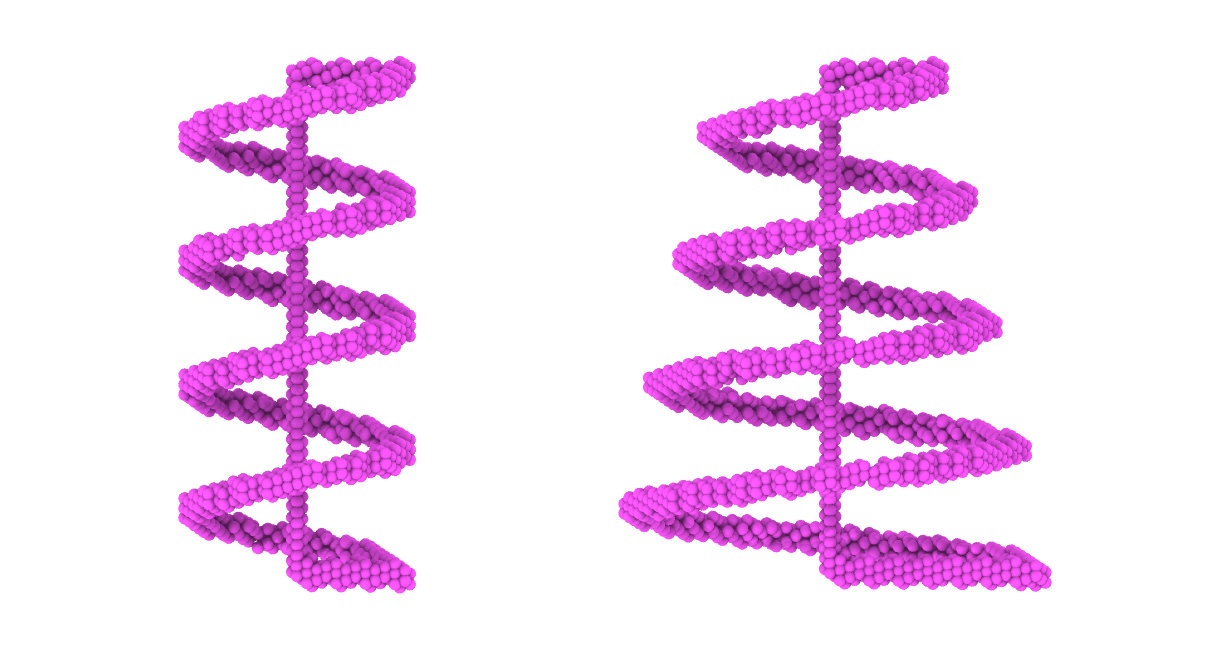
Dislocation helices with uniform radius (left) and with linearly varying radius (right).
To create a dislocation helix,
Step 1:
Use the tool in subdirectory tools/Bcc to creat a BCC single crystal sample:
bcc_reg.lmp, use the tool in subdirectory Tool/Helical_surface to create the mesh of a helical surface:mesh.dat;
1#to create bcc_reg.lmp
2Bcc 200 200 200 -x 1 -1 0 -y 1 1 -2 -z 1 1 1 Fe
3
4#to generate data file of a hellcal surface mesh
5Helical_surface -xg 1 -1 0 -yg 1 1 -2 -zg 1 1 1 -xl 1 1 -2 -yl -1 1 0 -zl 1 1 1 25 1440 30
Step 2:
Open terminal, run the following command:
1CryDisGen para_file bcc_reg.lmp
Parameter file
Content of the para_file:
 1#lines starting with '#' are comments
 2#crystal region definition
 3Region
 4-x     1 -1  0         # lattice orientation along x-axis
 5-y     1  1 -2         # lattice orientation along y-axis
 6-z     1  1  1         # lattice orientation along z-axis
 7-lat   2.867           # lattice constant of Fe
 8-pbc   1 1 1           # boundary condition flags along x/y/z-axes: '1' for periodic, '0' for non-periodic
 9
10#dislocation helix
11nHelix 1               # number of dislocation helices
12Helix                  # label for dislocation helix section
13-bvh   1  1  1         # orientation of the Burgers vecotr for the helix
14-bsh   1/2             # scalar coefficient of Burgers vector, e.g., 1/2 in 1/2<110>
15-f     mesh.dat        # mesh data file of the helical surface